Toggle light / dark theme

A material with a particular twist

In a material made of two thin crystal layers that are slightly twisted with respect to each other, researchers at ETH have studied the behavior of strongly interacting electrons. Doing so, they found a number of surprising properties.

Many modern technologies are based on special materials, such as the semiconductors that are important for computers, inside of which can move more or less freely. Exactly how free those electrons are is determined by their quantum properties and the crystal structure of the material. Most of the time they move independently of each other. Under certain conditions, however, between the electrons can give rise to particular phenomena. Superconductors, in which electrons pair up to conduct electrical current without resistance, are a well-known example.

At the Institute for Quantum Electronics in Zurich, ETH-professor Ataç Imamoğlu investigates materials with strongly interacting electrons. He wants to understand the behavior of the electrons in those materials better and looks for unexpected properties that might be interesting for future applications. In a “twisted” material, he and his collaborators have now made some surprising discoveries regarding the behavior of electrons, as they report in the scientific journal Nature.
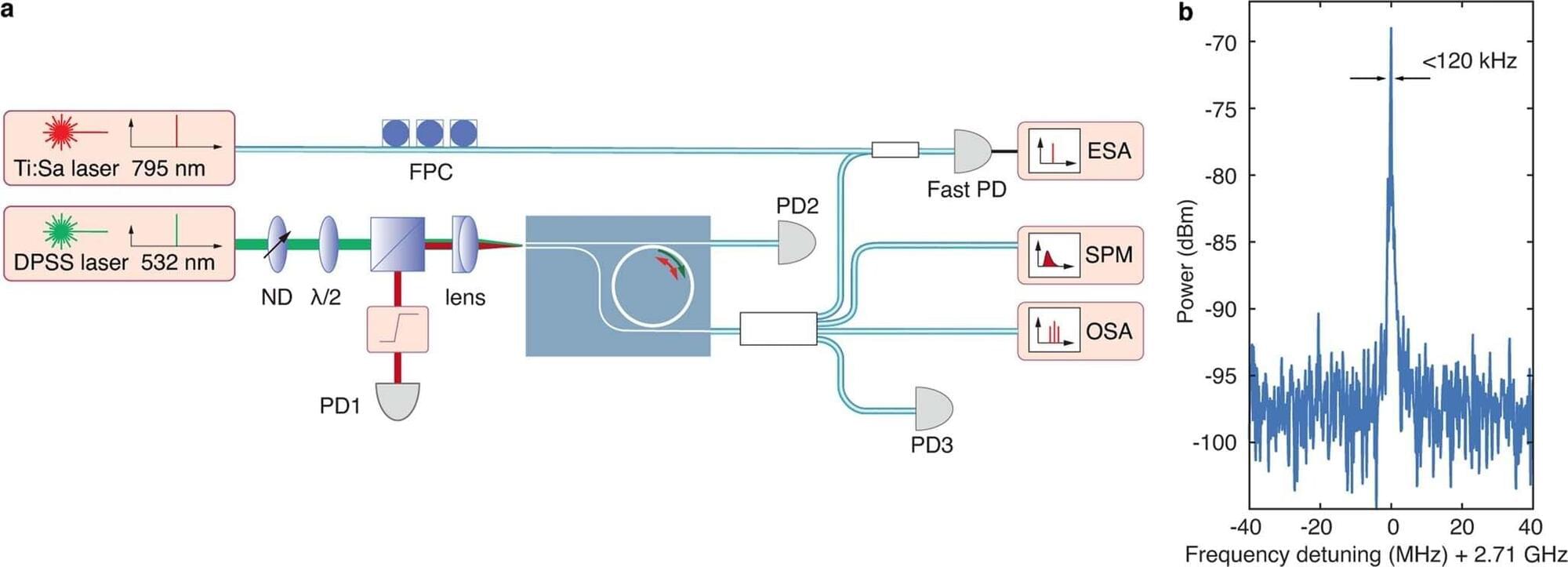
Development of the first chip-sized titanium-doped sapphire laser

A team of researchers has developed the first chip-scale titanium-doped sapphire laser—a breakthrough with applications ranging from atomic clocks to quantum computing and spectroscopic sensors.

The work was led by Hong Tang, the Llewellyn West Jones, Jr. Professor of Electrical Engineering, Applied Physics & Physics. The results are published in Nature Photonics.

When the titanium-doped laser was introduced in the 1980s, it was a major advance in the field of lasers. Critical to its success was the material used as its gain medium—that is, the material that amplifies the laser’s energy. Sapphire doped with titanium ions proved to be particularly powerful, providing a much wider laser emission bandwidth than conventional semiconductor lasers. The innovation led to fundamental discoveries and countless applications in physics, biology, and chemistry.

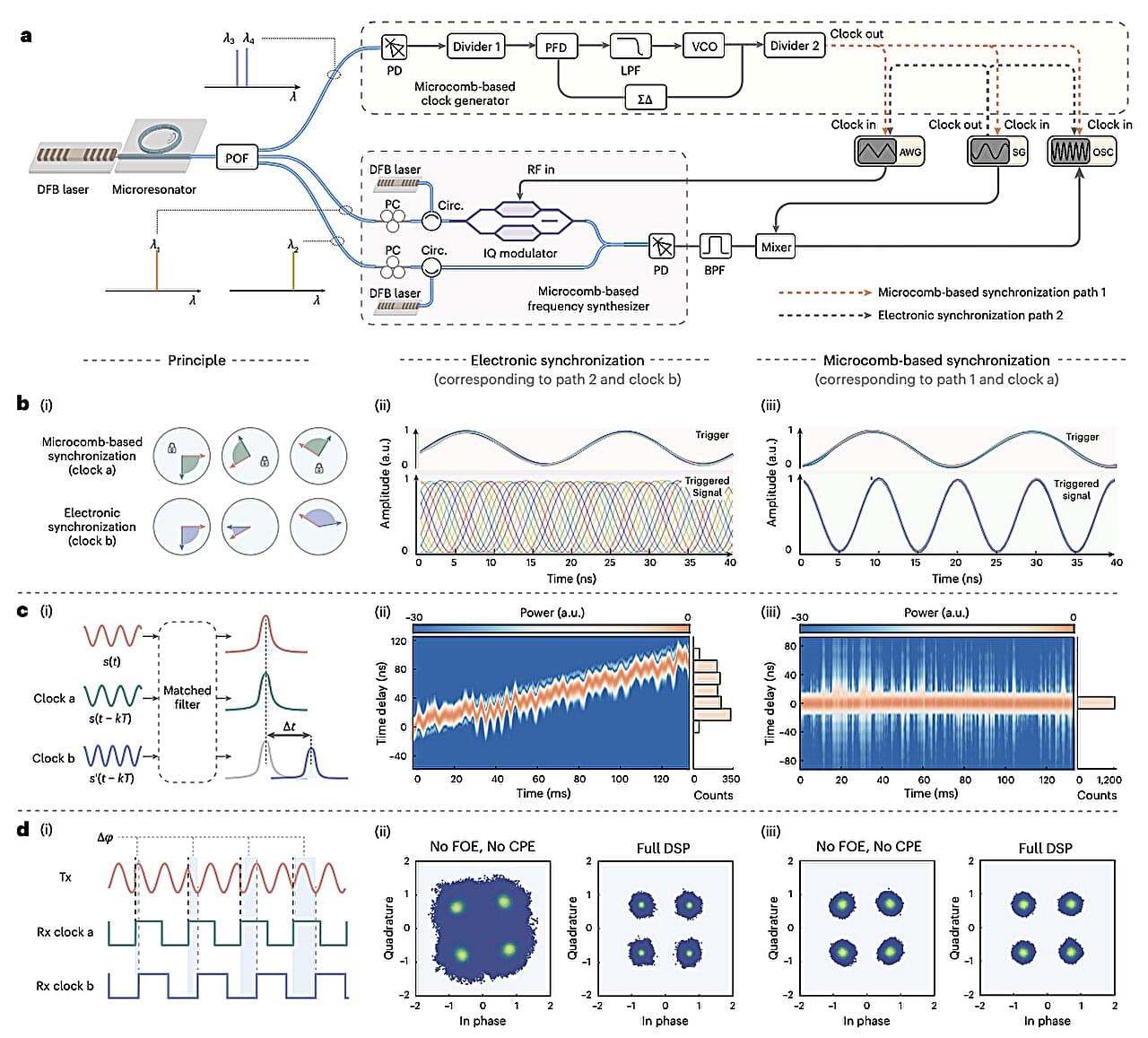
A new on-chip microcomb to synchronize signals in optoelectronics

Optoelectronics are promising devices that combine optical components, which operate leveraging light, with electronics, which leverage electrical current. Optoelectronic systems could transmit data faster than conventional electronics, thus opening new possibilities for the development of high-speed communication technology.

Despite their potential, the deployment of optoelectronics has so far been limited, in part due to reported difficulties in synchronizing optically generated signals with those of traditional electronic clocks. These signals are difficult to synchronize as optical and electronic components typically operate at different frequencies.

The frequencies of optical signals (i.e., generally hundreds of gigahertz) are generally significantly higher than those of , which range from megahertz to a few gigahertz. This mismatch in frequencies makes aligning the frequencies of the two types of components challenging, which in turn adversely impacts the reliability and efficiency of optoelectronics.

Lightening the load of augmented reality glasses

An international team of scientists developed augmented reality glasses with technology to receive images beamed from a projector, to resolve some of the existing limitations of such glasses, such as their weight and bulk. The team’s research is being presented at the IEEE VR conference in Saint-Malo, France, in March 2025.

Augmented reality (AR) technology, which overlays and virtual objects on an image of the real world viewed through a device’s viewfinder or , has gained traction in recent years with popular gaming apps like Pokémon Go, and real-world applications in areas including education, manufacturing, retail and health care. But the adoption of wearable AR devices has lagged over time due to their heft associated with batteries and electronic components.

AR glasses, in particular, have the potential to transform a user’s physical environment by integrating virtual elements. Despite many advances in hardware technology over the years, AR glasses remain heavy and awkward and still lack adequate computational power, battery life and brightness for optimal user experience.

World’s 1st modular quantum computer that can operate at room temperature goes online

Scientists have developed a quantum computer that uses light to process data, paving the way for quantum computers that can operate in a networked environment at room temperature.

The new system, called Aurora, is the first photonic quantum computer in the world that can operate at scale using several modules interconnected through fiber optic cables. The system presents a solution to some of quantum computing’s biggest problems — namely operation at scale, fault tolerance and error correction, Xanadu representatives say.

Physicists “Slow Down Light” to Just 61 Kilometers per Hour Using Ultracold Quantum Matter

The speed of light is often regarded as the ultimate cosmic speed limit, but researchers have now managed to slow it down dramatically—to just 61 kilometers per hour. This was achieved by using a Bose-Einstein condensate (BEC), a peculiar quantum state of matter that allows light to be slowed or even stopped entirely. This discovery, which builds on decades of research, has implications for quantum physics, computing, and information storage.

The Quantum Jelly Effect In everyday conditions, light moves at 299,792,458 meters per second in a vacuum, and its speed decreases slightly when passing through materials like glass or water. However, these reductions are relatively small. In contrast, when light travels through a Bose-Einstein condensate, it can be slowed to a near standstill.

A Bose-Einstein condensate is an exotic state of matter, first predicted by Albert Einstein and Satyendra Nath Bose, that occurs when a gas is cooled to temperatures just above absolute zero. Under these conditions, the atoms behave as a single quantum entity, exhibiting superfluidity and interacting with light in ways not seen in ordinary materials.

Quantum algorithm excels at finding local minima of many-body systems

Many physicists and engineers have recently been trying to demonstrate the potential of quantum computers for tackling some problems that are particularly demanding and are difficult to solve for classical computers. A task that has been found to be challenging for both quantum and classical computers is finding the ground state (i.e., lowest possible energy state) of systems with multiple interacting quantum particles, called quantum many-body systems.

When one of these systems is placed in a thermal bath (i.e., an environment with a fixed temperature that interacts with the systems), it is known to cool down without always reaching its . In some instances, a can get trapped at a so-called local minimum; a state in which its energy is lower than other neighboring states but not at the lowest possible level.

Researchers at California Institute of Technology and the AWS Center for Quantum Computing recently showed that while finding the local minimum for a system is difficult for classical computers, it could be far easier for quantum computers.

Neuralink, mind control and the law

On the weekend Elon Musk provided a live demonstration of Neuralink’s technology using pigs with surgically implanted brain monitoring devices. The Australian Society for Computers & Law invited Dr Michelle Sharpe (Victorian Barrister) and Dr Allan McCay (Lecturer and Author on Neurotechnology and the law) to explore the legal and ethical implications of technology that interfaces between the human brain and computer devices.

The Future of Neurotechnology | BCI’s | Brain Implants and More

Are you curious about the future of neurotechnology, learn more about brain implants and brain computer interfaces, commonly referred to as BCI’s?

We will look at that as well as the potential of neurotechnology and its implications for society? In this video, we’ll explore the ethical and societal implications of neurotechnology, from personal identity to privacy and security. We will also look at how neurorights can help protect us now as well as into the future. Join us on this journey to understand the complex ethical considerations that come with advances in neuroscience!

/* */