Toggle light / dark theme

Novel alloy withstands extreme conditions, could replace metals used in aircraft engines and gas turbines

A new material might contribute to a reduction of the fossil fuels consumed by aircraft engines and gas turbines in the future. A research team from Karlsruhe Institute of Technology (KIT) has developed a refractory metal-based alloy with properties unparalleled to date.

The novel combination of chromium, molybdenum, and silicon is ductile at . With its of about 2,000°C, it remains stable even at high temperatures and is at the same time oxidation resistant. These results are published in Nature.

High-temperature-resistant metallic materials are required for , , X-ray units, and many other technical applications. Refractory metals such as tungsten, molybdenum, and chromium, whose melting points are around or higher than 2,000°C, can be most resistant to high temperatures.


Research shines light on ‘double-yielding’ behavior in soft materials

For decades, scientists have observed, but been unable to explain, a phenomenon seen in some soft materials: When force is applied, these materials exhibit not one, but two spikes in energy dissipation, known as overshoots. Because overshoots are generally thought to indicate the point at which a material yields, or transitions from solid-like to fluid-like behavior, the dual response was therefore assumed to indicate “double yielding”—the idea that to fully fluidize a material, it needed to yield twice.

Now, researchers at the University of Illinois Urbana-Champaign have shown that this behavior is different than previously hypothesized. Their paper, “Resolving Dual Processes in Complex Oscillatory Yielding,” is published in Physical Review Letters.

In the study, chemical and biomolecular engineering professor Simon A. Rogers and his team, led by then-graduate student James J. Griebler show that the two-step response is the result of two independent processes: first, a softening of the material’s elastic structure, and later, true yielding.

Smart microfibers turn everyday objects into health care monitors and energy devices

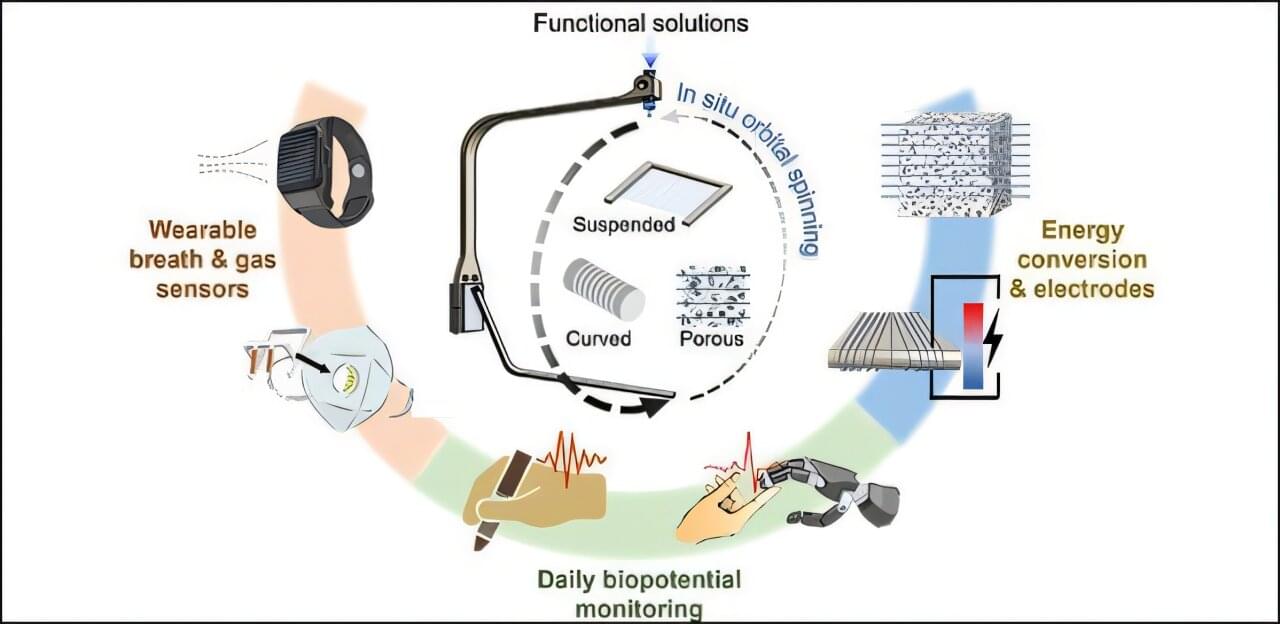
New research led by the University of Cambridge, in collaboration with Hong Kong University of Science and Technology (GZ) and Queen Mary University of London, could redefine how we interact with everyday tools and devices—thanks to a novel method for printing ultra-thin conductive microfibers.

Imagine fibers thinner than a human hair (nano-to micro-scale in diameter) that can be tuned on-demand to add sensing, energy conversion and electronic connectivity capabilities to objects of different shapes and surface textures (such as glass, plastic and leather). This is what the researchers have achieved, including in unconventional materials like porous graphene aerogels, unlocking new possibilities for human-machine interaction in various everyday settings.

The researchers present a one-step adaptive fiber deposition process using 3Dprinting, set up to satisfy the fast-changing demands of users. The process enables the on-demand deployment of conductive material layers on different surface areas, dependent on the model’s geometry, at the point of use. The findings are reported in the journal Advanced Fiber Materials.

How order and disorder direct chemical reactivity

In nature, the behavior of systems—whether large or small—is always governed by a few fundamental principles. For instance, objects fall downward because it minimizes their energy. At the same time, order and disorder are key variables that also shape physical processes. Systems—especially our homes—tend to become increasingly disordered over time. Even at the microscopic level, systems tend to favor increased disorder, a phenomenon known as an increase in so-called entropy.

These two variables—energy and entropy—play an important role in . Processes occur automatically when energy can be reduced or entropy (disorder) increases.

Under standard conditions—such as in a glass of water—water autodissociation is hindered by both factors, making it a highly unlikely event. However, when strong electric fields are applied, the process can be dramatically accelerated.

Researchers integrate waveguide physics into metasurfaces for advanced light control

Ultrathin structures that can bend, focus, or filter light, metasurfaces are reshaping how scientists think about optics. These engineered materials offer precise control over lights behavior, but many conventional designs are held back by inefficiencies. Typically, they rely on local resonances within individual nanostructures, which often leak energy or perform poorly at wide angles. These shortcomings limit their usefulness in areas like sensing, nonlinear optics, and quantum technologies.

A growing area of research looks instead to nonlocal metasurfaces, where interactions between many elements create collective optical effects. These collective behaviors can trap light more efficiently, producing sharper resonances and stronger interactions with matter. One of the most promising possibilities in this field is the development of photonic flatbands, where resonant behavior stays uniform across a wide range of viewing angles.

Another is creating chiral responses, which allow devices to distinguish between left-and right-handed circularly polarized light. Until now, however, achieving both flatband and chiral behavior with high efficiency on a single platform has remained a major challenge.

Physicist: After 33 billon years, universe ‘will end in a big crunch’

The universe is approaching the midpoint of its 33-billion-year lifespan, a Cornell physicist calculates with new data from dark-energy observatories. After expanding to its peak size about 11 billion years from now, it will begin to contract – snapping back like a rubber band to a single point at the end.

Henry Tye, the Horace White Professor of Physics Emeritus in the College of Arts and Sciences, reached this conclusion after adding new data to a model involving the “cosmological constant” – a factor introduced more than a century ago by Albert Einstein and used by cosmologists in recent years to predict the future of our universe.

“For the last 20 years, people believed that the cosmological constant is positive, and the universe will expand forever,” Tye said. “The new data seem to indicate that the cosmological constant is negative, and that the universe will end in a big crunch.”

/* */