Toggle light / dark theme

Water Droplets Are Generating Electricity in a Way We Never Knew

Scientists have discovered that water moving over surfaces generates significantly more electrical charge than previously believed, particularly when it sticks and then slips past tiny obstacles.

This newfound knowledge could revolutionize surface design for safer fuel storage, better energy storage, and even faster charging technologies.

Water generates more electricity than expected.

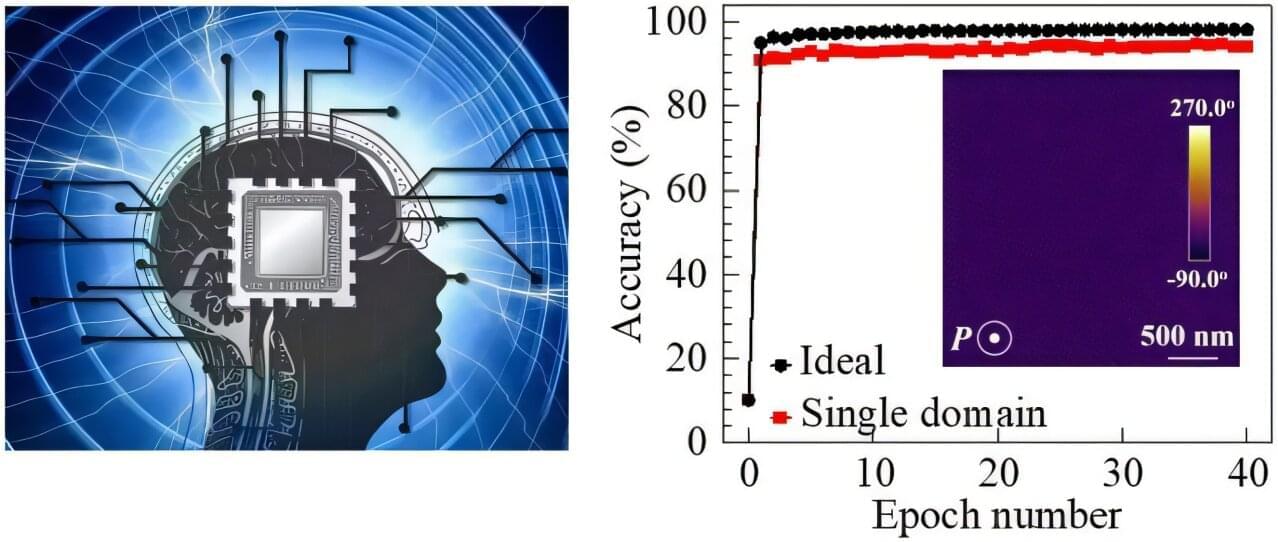
Researchers achieve single-domain ferroelectric thin films through simple temperature control

A research team led by Prof. Hu Weijin from the Institute of Metal Research (IMR) of the Chinese Academy of Sciences has discovered that single-domain ferroelectric thin films can be efficiently achieved by simply elevating the growth temperature.

Their findings, published in Advanced Functional Materials, offer a straightforward alternative to conventional complex fabrication methods, with significant implications for ferroelectric device performance.

Ferroelectric materials naturally form polydomain structures to minimize electrostatic energy. Nevertheless, single-domain can be achieved through precise control of interfacial atomic layers or strain gradients. The quest for a simple method to obtain a single-domain state and its impact on ferroelectric device performance are of great interest.
NASA’s EZIE Mission Will Track Earth’s Hidden Electric Highways to Predict Space Storms

NASA’s upcoming EZIE mission will use three small satellites to study electrojets — powerful electrical currents in the upper atmosphere linked to auroras. These mysterious currents influence geomagnetic storms that can disrupt satellites, power grids, and communication systems. By mapping how electrojets evolve, EZIE will improve space weather predictions, helping to safeguard modern technology.

Full Throttle, Mach Diamonds: NASA’s X-59 Turns Up Power, Soars Through Engine Tests

NASA’s X-59 has cleared another hurdle with the successful completion of critical engine tests. The trials confirmed that its F414-GE-100 engine, adapted from the F-18 Super Hornet, performs as expected at full power. The aircraft’s design, including its unique top-mounted engine and elongated nose, aims to soften sonic booms to a mere “thump.” As NASA prepares for the first flight, additional tests will ensure the aircraft is ready for safe operation.

Dyson Spheres? Important Updates on Strange Objects Discovered in 2024!

The HEOS project is searching space for signs of Dyson Spheres. Funded by the Swedish government, the project not only believes that these extraterrestrial power plants are possible, but also assumes that we can detect them. Dyson spheres are power plants that hypercivilizations build in space to harness incredible amounts of energy. Will HEOS soon enable us to make contact with an extraterrestrial species for the first time?

Pure nickel oxide research refutes hydrogen-superconductivity link

Physicists from the National University of Singapore (NUS) have synthesized very pure superconducting materials and redefined the critical role of hydrogen in the newly discovered nickel-oxide superconductors.

Their findings were published concurrently in the journals Nature Communications and Physical Review Letters.

Superconductivity is an exciting phenomenon where electrical resistance disappears, and it holds transformative potential for revolutionizing energy technologies. Despite its potential, the origin and fundamental mechanism of remain one of the greatest mysteries in physics.

/* */