Toggle light / dark theme

Scientists Discover New Heavy-Metal Molecule ‘Berkelocene’

A research team led by the Department of Energy’s Lawrence Berkeley National Laboratory (Berkeley Lab) has discovered “berkelocene,” the first organometallic molecule to be characterized containing the heavy element berkelium.

Organometallic molecules, which consist of a metal ion surrounded by a carbon-based framework, are relatively common for early actinide elements like uranium (atomic number 92) but are scarcely known for later actinides like berkelium (atomic number 97).

“This is the first time that evidence for the formation of a chemical bond between berkelium and carbon has been obtained. The discovery provides new understanding of how berkelium and other actinides behave relative to their peers in the periodic table,” said Stefan Minasian, a scientist in Berkeley Lab’s Chemical Sciences Division and one of four co-corresponding authors of a new study published in the journal Science.


Breakthrough in heavy-element chemistry shatters long-held assumptions about transuranium elements.

Gaps identified in gravity wave simulations over Antarctica

Spotting flaws is sometimes the first ripple in making waves of innovation.

Comparing directly observed with the latest advanced simulations, researchers from the Research Organization of Information and Systems (ROIS) and their colleagues have revealed significant limitations in current atmospheric modeling. Their findings emphasize the complexities of these atmospheric waves and their impacts on weather and climate systems.

The study was published in the Journal of the Meteorological Society of Japan on Sept. 2.

Four small planets found orbiting the closest single star to Earth

Each is calculated to be just 20 to 30% the mass of Earth and completes one full trip around the star in only a few days.

These findings have caught many people’s attention because they point to greater precision in detecting smaller, more elusive planets.

“It’s a really exciting find – Barnard’s Star is our cosmic neighbor, and yet we know so little about it,” said Ritvik Basant, Ph.D. student at the University of Chicago and first author on the study. “It’s signaling a breakthrough with the precision of these new instruments from previous generations.”

New treatment could cure one in 20 cases of high blood pressure

Half a million people in the UK with dangerously high blood pressure – a “silent killer” that causes tens of thousands of deaths a year – could be cured by a new treatment.

Doctors have developed a technique to burn away nodules that lead to a large amount of salt building up in the body, which increases the risk of a stroke or heart attack.

The breakthrough could mean people with primary aldosteronism – which causes one in 20 cases of high blood pressure – no longer have to have surgery or spend their lives taking the drug spironolactone to lower their risk of a stroke or heart attack.

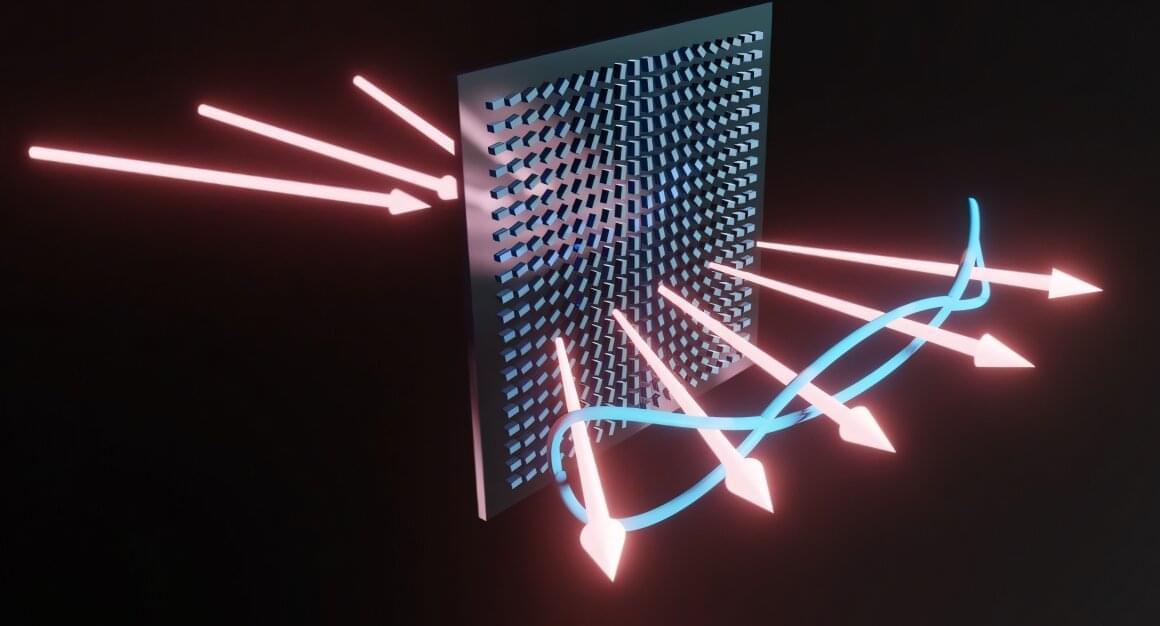
Metasurface technology offers a compact way to generate multiphoton entanglement

Quantum information processing is a field that relies on the entanglement of multiple photons to process vast amounts of information. However, creating multiphoton entanglement is a challenging task. Traditional methods either use quantum nonlinear optical processes, which are inefficient for large numbers of photons, or linear beam-splitting and quantum interference, which require complex setups prone to issues like loss and crosstalk.

A team of researchers from Peking University, Southern University of Science and Technology, and the University of Science and Technology of China have made a significant breakthrough in this area.

As reported in Advanced Photonics Nexus, they developed a new approach using metasurfaces, which are planar structures capable of controlling various aspects of light, such as phase, frequency, and polarization. This innovative approach allows for the generation of multiphoton entanglement on a single , simplifying the process while making it more efficient.

A breakthrough in 6G and terahertz waves has been achieved thanks to an innovative electromagnetic absorber

The world of wireless communications is on the brink of a major leap forward. With 6G promising blazing speeds and near-zero latency, the future of connectivity is closer than ever. However, harnessing terahertz waves—which could deliver these unmatched data rates—has been hampered by interference issues. A team of researchers has now turned the tide with a revolutionary electromagnetic absorber.

New AI defense method shields models from adversarial attacks

Neural networks, a type of artificial intelligence modeled on the connectivity of the human brain, are driving critical breakthroughs across a wide range of scientific domains. But these models face significant threat from adversarial attacks, which can derail predictions and produce incorrect information.

Los Alamos National Laboratory researchers have now pioneered a novel purification strategy that counteracts adversarial assaults and preserves the robust performance of . Their research is published on the arXiv preprint server.

“Adversarial attacks to AI systems can take the form of tiny, near-invisible tweaks to input images, subtle modifications that can steer the model toward the outcome an attacker wants,” said Manish Bhattarai, Los Alamos computer scientist. “Such vulnerabilities allow malicious actors to flood digital channels with deceptive or harmful content under the guise of genuine outputs, posing a direct threat to trust and reliability in AI-driven technologies.”

/* */