Toggle light / dark theme

DNA Study of 117-Year-Old Woman Reveals Clues to a Long Life

There’s no escaping the unrelenting passage of time, but supercentenarians who live to see their 110th birthday have a peculiar ability to postpone the inevitable.

A thorough health evaluation of one of the world’s oldest people, Maria Branyas, suggests that one of the reasons she lived to 117 was that she possessed an exceptionally young genome.

Some of her rare genetic variants are linked to longevity, immune function, and a healthy heart and brain.

This Popular Diet Seems to Reduce Gum Disease, Scientists Say

There’s something rather special about the Mediterranean diet: already associated with a lower risk of Alzheimer’s disease, early death, poor mental health, and more besides, a new study links the diet to better gum health too.

The study, carried out by researchers from King’s College London and the University of Catania in Italy, involved 195 participants with an average age of 49, who were given a health check-up and quizzed on their dietary habits.

Those participants who stuck more closely to the plant-rich Mediterranean diet were less likely to have gum disease, the data showed – especially those who didn’t eat much red meat.

A review of the sufficient conditions for consciousness

In a recently published article, I reviewed over 100 years of neuroscience research to see if some brain regions are more important than others for consciousness. What I found suggests scientists who study consciousness may have been undervaluing the most ancient regions of human brains.

Consciousness is usually defined by neuroscientists as the ability to have subjective experience, such as the experience of tasting an apple or of seeing the redness of its skin.

The leading theories of consciousness suggest that the outer layer of the human brain, called the cortex (in blue in figure 1), is fundamental to consciousness. This is mostly composed of the neocortex, which is newer in our evolutionary history.

The human subcortex (figure 1, brown/beige), underneath the neocortex, has not changed much in the last 500 million years. It is thought to be like electricity for a TV, necessary for consciousness, but not enough on its own.

There is another part of the brain that some neuroscientific theories of consciousness state is irrelevant for consciousness. This is the cerebellum, which is also older than the neocortex and looks like a little brain tucked in the back of the skull (figure 1, purple). Brain activity and brain networks are disrupted in unconsciousness (like in a coma). These changes can be seen in the cortex, subcortex and cerebellum.

As part of my analysis I looked at studies showing what happens to consciousness when brain activity is changed, for example, by applying electrical currents or magnetic pulses to brain regions.

These experiments in humans and animals showed that altering activity in any of these three parts of the brain can alter consciousness. Changing the activity of the neocortex can change your sense of self, make you hallucinate, or affect your judgment.


New Huntington’s Disease Therapy Slows Patients’ Disease by 75%

Huntington’s disease is a genetic disorder that is caused by an unusual number of repeats in the huntingtin gene; there make the gene too long, and lead to the production of a toxic protein in brain cells. Symptoms of the disease tend to arise when a person is in their 30s or 40s and it is typically fatal within 20 years. New work may change that, however.

Scientists Identify Brain Signal Disruptions Behind Voices in Schizophrenia

A new study reveals a missing area of brain activity in the minds of people with schizophrenia who hear voices.

The analysis of brain wave data suggests a combination of two neurological functions could trigger auditory verbal hallucinations.

Researchers from China found evidence of a breakdown in the ability to prepare the senses for specific words to be spoken. This on its own, however, isn’t enough; another area that filters our brain’s internal chatter is also enhanced in those with schizophrenia who experience unsettling auditory hallucinations.

In a first, scientists observe short-range order in semiconductors

Inside the microchips powering your devices, atoms aren’t just randomly scattered. They follow a hidden order that can change how semiconductors behave.

A team of researchers from the Lawrence Berkeley National Laboratory (Berkeley Lab) and George Washington University has, for the first time, observed these tiny patterns, called short-range order (SRO), directly in semiconductors.

This discovery is a game-changer, as understanding how atoms naturally arrange themselves could let researchers design materials with desirable electronic properties. Such control could revolutionize quantum computing, neuromorphic devices that mimic the brain, and advanced optical detectors.

Time-released gel packs a one-two punch against aggressive brain tumors

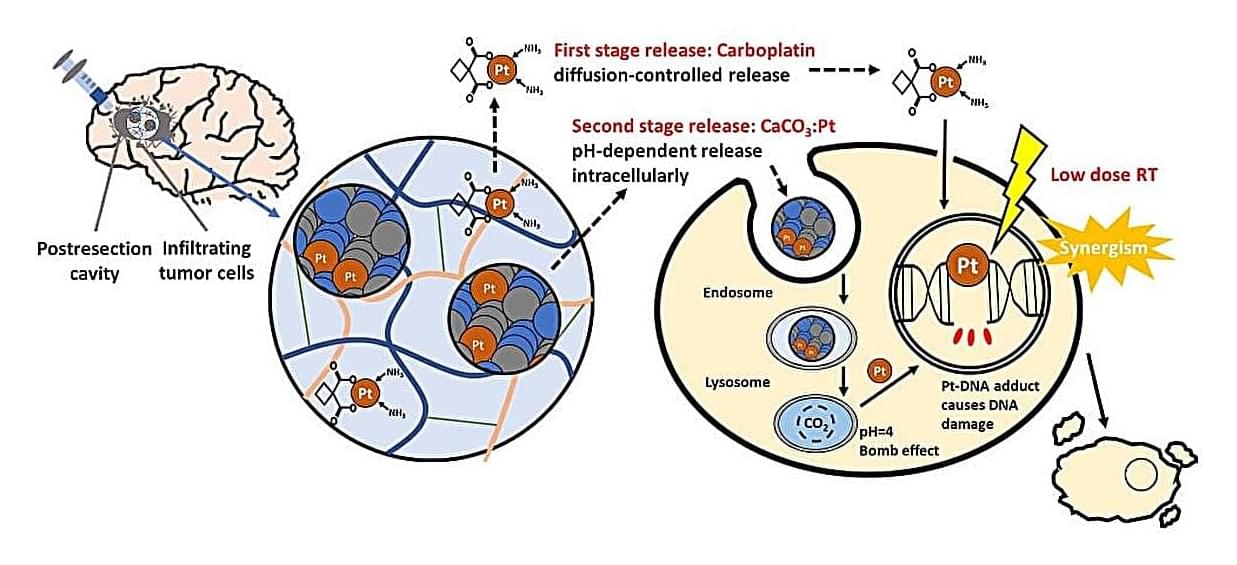
High-grade gliomas are aggressive brain tumors with poor prognosis, largely because even after surgical removal, infiltrative residual tumor cells often regrow during the latency before radiotherapy, leading to recurrence. The standard chemoradiotherapy only modestly improves survival. A crucial window of vulnerability arises post-surgery, before radiotherapy begins, where residual tumor cells are not well addressed by systemic chemotherapy.

Prof. Feng-Huei Lin and Dr. Jason Lin from National Taiwan University have designed a local post-surgical gel packing with sequential delivery of platinum agents that could maintain therapeutic drug concentrations intracranially and synergize with subsequent radiotherapy to eliminate tissue. Their study is published in the Chemical Engineering Journal.

The cutting-edge drug-delivery gel can be directly injected into the surgical cavity following tumor resection. This gel provides sustained local delivery of platinum-based anticancer agents, ensuring effective eradication for residual glioma tissue that remain after surgery. The gel is designed to maximize the therapeutic impact while minimizing systemic exposure.

How the brain decides which moments you’ll never forget

Boston University researchers found that ordinary moments can gain staying power if they’re connected to significant emotional events. Using studies with hundreds of participants, they showed that the brain prioritizes fragile memories when they overlap with meaningful experiences. This could help explain why we recall certain details surrounding big events and may lead to new ways of boosting learning and treating memory disorders.

New Study Finds Evidence of Hepatitis C Virus in Cells Lining Human Brain

Observational studies of psychiatric diseases such as schizophrenia, bipolar disorder and major depression have long tied viral infections with behavioral symptoms in these disorders, but scientists have been unable to find direct evidence of suspected viruses in the brain. Experts say that’s possibly because viruses may not get directly inside the brain, but may target the brain lining instead.

After testing that idea using postmortem human brain samples and the electronic medical records of 285 million patients, a team of Johns Hopkins Medicine scientists says it has found such evidence in the form of the liver-damaging hepatitis C virus in the human brain’s choroid plexus, a collection of cells that make up the lining of the fluid-filled cavities, or ventricles, and — notably — produce the cerebrospinal fluid that protects the brain and spinal cord…

…’Our findings show that it’s possible that some people may be having psychiatric symptoms because they have an infection, and since the hepatitis C infection is treatable, it might be possible for this patient subset to be treated with antiviral drugs and not have to deal with psychiatric symptoms,’ Sabunciyan says.

/* */