Toggle light / dark theme

Tiny granules can help bring clean and abundant fusion power to Earth

Beryllium, a hard, silvery metal long used in X-ray machines and spacecraft, is finding a new role in the quest to bring the power that drives the sun and stars to Earth. Beryllium is one of the two main materials used for the wall in ITER, a multinational fusion facility under construction in France to demonstrate the practicality of fusion power. Now, physicists from the U.S. Department of Energy’s (DOE) Princeton Plasma Physics Laboratory (PPPL) and General Atomics have concluded that injecting tiny beryllium pellets into ITER could help stabilize the plasma that fuels fusion reactions.

Experiments and computer simulations found that the injected granules help create conditions in the that could trigger small eruptions called edge-localized modes (ELMs). If triggered frequently enough, the tiny ELMs prevent giant eruptions that could halt fusion reactions and damage the ITER facility.

Scientists around the world are seeking to replicate fusion on Earth for a virtually inexhaustible supply of power to generate electricity. The process involves plasma, a very hot soup of free-floating electrons and , or ions. The merging of the nuclei releases a tremendous amount of energy.

Fermi Paradox: First Contact with Alien Syntellects in Extra Dimensions is More Than a Possibility

I used to think that we live in some sort of a “cosmic jungle”, so the Zoo Hypothesis (like Star Trek Prime Directive) should be the correct explanation to the Fermi Paradox, right? I wouldn’t completely rule out this hypothesis insofar as a theorist Michio Kaku allegorically compares our earthly civilization to an “anthill” next to the “ten-lane superhighway” of a galactic-type civilization. Over time, however, I’ve come to realize that the physics of information holds the key to the solution of the Fermi Paradox — indications are we most likely live in a “syntellect chrysalis” instead of a “cosmic jungle.”

Just like a tiny mustard seed in the soil, we’ll get to grow out of the soil, see “the light of the day” and network by roots and pollen with others, at the cosmic level of emergent complexity — as a civilizational superorganism endowed with its own advanced extradimensional consciousness. So, one day our Syntellect, might “wake up” as some kind of a newborn baby of the intergalactic family (or multiversal family, for that matter – that remains to be seen) within the newly perceived reality framework. Call it the Chrysalis Conjecture, if you’d like.*.

Lightning bolt underwater

Electrochemical cells help recycle CO2. However, the catalytic surfaces get worn down in the process. Researchers at the Collaborative Research Centre 1316 “Transient atmospheric plasmas: from plasmas to liquids to solids” at Ruhr-Universität Bochum (RUB) are exploring how they might be regenerated at the push of a button using extreme plasmas in water. In a first, they deployed optical spectroscopy and modelling to analyse such underwater plasmas in detail, which exist only for a few nanoseconds, and to theoretically describe the conditions during plasma ignition. They published their report in the journal Plasma Sources Science and Technology on 4 June 2019.

Plasmas are ionised gases: they are formed when a gas is energised that then contains free electrons. In nature, plasmas occur inside stars or take the shape of polar lights on Earth. In engineering, plasmas are utilised for example to generate light in fluorescent lamps, or to manufacture new materials in the field of microelectronics. “Typically, plasmas are generated in the gas phase, for example in the air or in noble gases,” explains Katharina Grosse from the Institute for Experimental Physics II at RUB.

Incredible Observation Links Two Different Radioactive Phenomena Inside a Thunderstorm

Scientists in Japan reported seeing two radioactive weather phenomena at the same time, for the first time, according to a new paper. The observation establishes a link between the two, adding to our knowledge of the wild physics that takes place inside thunderstorms.

The researchers reported the “unequivocal simultaneous detection” of a minute-long “gamma-ray glow” followed by a powerful, millisecond-long “terrestrial gamma-ray flash,” or TGF. Though scientists have observed these two events before, they don’t quite understand the connection between—the glows and flashes have never been observed together. That is, until now.

Physicists create world’s first multiverse of universes in the lab

Researchers at the University of Maryland, College Park and Towson University are reporting that they have created multiple universes inside a laboratory-created multiverse — a world first.

To be exact, the researchers created a metamaterial — like those used to fashion invisibility cloaks — that, when light passes through it, multiple universes are formed within it. These universes, called Minkowski spacetimes, are similar to our own, except they more neatly tie up Einstein’s theory of special relativity by including time as a fourth dimension.

While this is rather extraordinary, the experimental setup is actually quite simple — though definitely rather unconventional. The multiverse is created inside a solution of cobalt in kerosene. This fluid isn’t usually considered a metamaterial, but lead researcher Igor Smolyaninov and co found that by applying a magnetic field, the ferromagnetic nanoparticles of cobalt line up in neat columns. When light passes through these columns, it behaves as if it’s in a Minkowski universe.

Designing light-harvesting organic semiconductor microcrystals with wavelength-tunable lasers

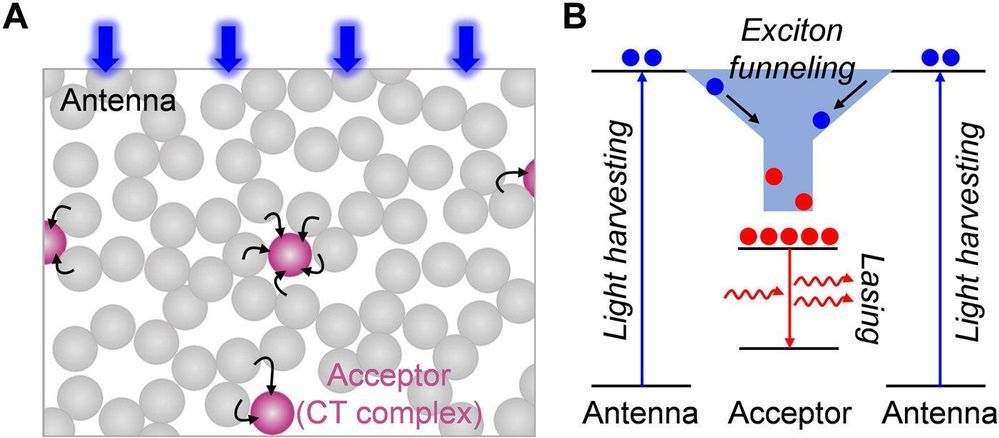
Organic solid-state lasers are essential for photonic applications, but current-driven lasers are a great challenge to develop in applied physics and materials science. While it is possible to create charge transfer complexes (i.electron-donor-acceptor complexes among two/more molecules or across a large molecule) with p-/n- type organic semiconductors in electrically pumped lasers, the existing difficulties arise from nonradiative loss due to the delocalized states of charge transfer (CT). In a recent report, Kang Wang and a team of researchers in the departments of chemistry, molecular nanostructure and nanotechnology in China demonstrated the enduring action of CT complexes by exciton funneling in p-type organic microcrystals with n-type doping.

They surrounded locally formed CT complexes containing narrow bandgaps with hosts of high levels of energy to behave as artificial light-harvesting systems. They captured the resulting excitation light energy using hosts to deliver to the CT complexes for their function as exciton funnels in order to benefit lasing actions. Wang et al. expect the to offer in depth understanding of exciton funneling in light-harvesting systems to develop high-performance organic lasing devices. The new results are now available on Science Advances.

Organic semiconductor lasers that function across the full visible spectrum are of increasing interest due to their practical applications from multiband communication to full-color laser displays. Although they are challenging to attain, electrically pumped organic lasers can advance the existing laser technology to rival organic light-emitting diodes.

/* */