Toggle light / dark theme

World’s first 3D-printed cornea made from algae and human stem cells

The human eye is a remarkably sophisticated organ and like the lens to a camera, it’s the cornea that focuses the flood of photons into a perceptible image. But for an estimated 15 million people around the world, eye disease and trauma make surgery the only path to clear vision.

In the next few years, artificial corneas may become more accessible thanks to new research out of Newcastle University in the United Kingdom. There, researchers mixed stem cells from the cornea of a healthy donor with collagen and algae molecules to create a bio-ink, which they 3D-printed into an artificial cornea. The research is currently just a proof-of-concept but lays the groundwork for future techniques to create low-cost, easy-to-produce bionic eyes.

There were three features required for the bio-ink, according to Che Connon, a professor of tissue engineering at Newcastle.


Heroes of Innovation: Zoltan Istvan

I’ll be speaking at the exciting Future Flux Festival on the Heroes of Innovation program section on June 15 in the Netherlands. Come join me! https://www.futurefluxfestival.nl/…/heroes-of-innovation-z…/ #transhumanism


Transhumanism is the field of merging human beings with machines and radical science. The field has grown from fringe to a nearly mainstream social movement. Today, there are tens of millions of transhumanists around the world, many who are scientists and technologists focusing on overcoming biological death with innovation. The movement got a major push when Zoltan Istvan, a former journalist for National Geographic, published his bestselling philosophical novel The Transhumanist Wager. In 2016 Zoltan ran for the Presidency of the United States as the nominee of the Transhumanist Party. His campaign was broadly covered in major media for nearly two years, and it helped spearhead the transformation of transhumanism into a thriving worldwide phenomenon. Always wanted to know more about transhumanism? See you at the Future Flux Festival!

Zoltan Istvan is also part of our Heroes of Innovation panel. After their presentations you can ask our panel anything. Take a deep dive into the minds of these great innovators!

More information about Zoltan Istvan: www.zoltanistvan.com.

Video Player

Live forever or die trying: Meet the biohackers who fear their work could get them killed

Long story in The Independent: https://www.independent.co.uk/…/biohacking-transhumanism-aa… #transhumanism #biohacking


On the morning of 29 April, staff at the Soulex spa in Washington DC discovered the lifeless body of one of its clients lying face down in a sensory deprivation tank. The body was that of 28-year-old Aaron Traywick, who less than three months earlier had injected himself live on stage at an event in Austin, Texas, with an untested gene therapy that he claimed could cure herpes.

Stories soon spread about the discovery of Traywick’s body, with some inferring a potential link between the DIY herpes treatment and his untimely death. But those who knew the young entrepreneur and were familiar with the work he did suspected something much more sinister.

Traywick was part of a fringe but steadily growing community known as body hackers – or biohackers – whose modest goal is to cure disease, end ageing and ultimately stop death. “Why this test is so important,” he said on stage in Austin, just before injecting himself in the leg with the therapy, “is because if we succeed with herpes in even the most minor of ways, then we can move forward immediately with cancer.”

We want to declare ageing a disease

This in depth story has recently been translated to English: https://ciencias.uautonoma.cl/…/we-want-to-declare-ageing-a…?


Zoltan Istvan is currently a Libertarian candidate for Governor in California, also former 2016’s US presidential candidate for the Transhumanist Party and he is known around the world as someone that advocates for Transhumanism, a public figure in science and technology.

Dr. Marcela Gatica-Andrades and Nadia Politis from Science Communication Center interviewing Zoltan Istvan.

Pictures: Pablo Madariaga

#5 Transhumanism, Artificial Intelligence, and Universal Basic Income with Zoltan Istvan

A new podcast I did that talks about #transhmanism:


Zoltan Istvan is a transhumanist, futurist, author, and journalist. He’s a former reporter for National Geographic, ran for president in 2016, and is running for governor of California in 2018 under the libertarian party. In this episode we got into what transhumanism is, what his policy platforms are, and tackled a lot of the questions people generally have around these topics. Enjoy!

Follow Zoltan at @ zoltan_istvan on Twitter.

The Why Factor

I’m excited to announce my interview on the BBC World Service is airing around the world today multiple times to millions of people. My 4-min section on #transhumanism starts at 10:50.


Why do people chase immortality? We those who believe science is close to beating death.

Facing a future of ethical dilemmas

A new article out by Vicki Larson at the Marin Independent Journal that explores some #transhumanism.


I visited my parents’ grave on Mother’s Day, as I have every year since my mom died in 2010. I’ll be back on the 23rd, the fifth anniversary of my dad’s death.

I was fortunate to be able to tell them how much I loved them and appreciated everything they did for me before they died, so there are no regrets, nothing left unsaid. I miss them. A lot. But would I want to bring them back to life?

They’d no doubt be delighted to see the wonderful young men their only grandchildren have become. And I think they’d be pretty happy to know that I actually did get around to writing a book as I promised them I would as a teen, when I begged them to let me travel cross-country with friends to gather “research” for my Great American Novel instead of spending the summer working.

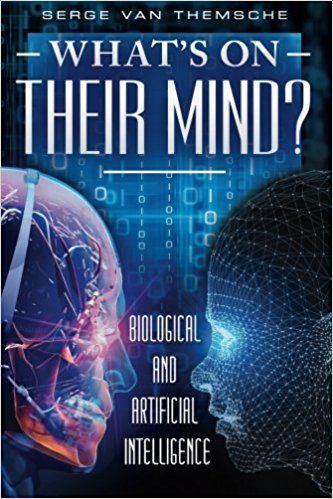
Biological and Artificial Intelligence

We all feel overwhelmed by the speed at which new computing technologies are being thrown at us, but we haven’t seen anything yet. With the upcoming breakthroughs in Artificial Intelligence technology, today’s computers will look like prehistoric tools, within just a few years. Systems are likely to follow suit, bringing us closer to strong AI, a moment when machines will be as smart as any human being. The question many fear is what will happen if and when machines become much brighter than us? In “What’s on their mind?” system consultant Serge Van Themsche describes through an engaging discussion with his driverless car, the main AI issues any concerned citizen should know about. This conversation resorts to hard and soft disciplines to better explain AIn this book you will get to understand: — What are biological and artificial knowledge, intelligence, and self-consciousness? — Which new neuroscience evidence shows how our brain programs data coming from our senses? — How can simple formulas, such as 2 power of i −1, explain how our neurons connect? — Can emotions be computable? — Can machines already create knowledge without any human interference? — Why must the computer industry mimic as closely as possible the brain functionalities to develop intelligent androids? — Why will AI be based on a discrete world rather than a digital one? — Will humans become super beings? This book will enable every reader, with or without a scientific or philosophical background, to grasp the similarities and differences between brains and computers. By doing so, he or she will not only figure out the likely paths AI will follow but also how humans will use these new technologies to transform themselves into super beings. Even though not all readers might be looking forward to Transhumanism, the movement that apprehends these modifications, they can get prepared for this future co-existence with smart robots. In the meantime, they will at least, gain a clear understanding of how their own mind works and why they become knowledgeable, intelligent, and self-aware.

What is the Singularity?

Not everyone is convinced. Critics point out that one of the points of exponential growth is that it cannot carry on forever. After a 50-year run, Moore’s Law is stuttering. Singularitarians retort that the laws of physics define a limit to how much computation you can cram into a given amount of matter, and that humans are nowhere near that limit. Even if Moore’s Law slows, that merely postpones the great day rather than preventing it. Others say the Singularity is just reli…gion in new clothes, reheated millenarianism with transistors and Wi-Fi instead of beards and thunderbolts. (One early proponent of Singularitarian and transhumanist ideas was Nikolai Federov, a Russian philosopher born in 1829 who was interested in resurrecting the dead through scientific means rather than divine ones.) And those virtual-reality utopias do look an awful lot like heaven. Perhaps the best way to summarise the Singularity comes from the title of a book published in 2012: the Rapture of the Nerds.


And will it lead to the extermination of all humans?

by T.C.

/* */